
Jab Kasai is one of the most sensitive topics on this site because it sits at the edge of several different worlds: Thai traditional bodywork, male pelvic health, testicular anxiety, sexual wellbeing language and real medical risk. A serious article has to start with that overlap. It cannot treat a cultural practice as a diagnosis, and it cannot turn testicular symptoms into a massage booking question. The testicles are vulnerable organs. Pain, swelling, lumps, fever, trauma and sudden changes deserve a clinical safety frame before any discussion of touch.
The purpose of this guide is not to teach a technique. It is to give readers a careful way to think. If a man is curious about Jab Kasai, the first questions should not be about pressure, duration or promised benefits. They should be about symptoms, contraindications, consent, hygiene, professional boundaries and referral. When those questions are answered well, a traditional wellbeing conversation can stay grounded. When they are ignored, the same topic can become unsafe very quickly.

Start with anatomy, not claims
The scrotum, testicles, epididymis, spermatic cord, blood vessels, nerves and surrounding pelvic tissues are not decorative details. They are the reason forceful pressure, guessing and performance-based claims are inappropriate. The testicles produce sperm and testosterone, but they also depend on blood supply, temperature regulation and nerve sensitivity. A symptom in this area may come from the testicle itself, the epididymis, the skin, a hernia, referred pelvic pain, infection, trauma or a vascular problem. Reading the symptom as blocked energy or tension before ruling out danger is not a safe sequence.
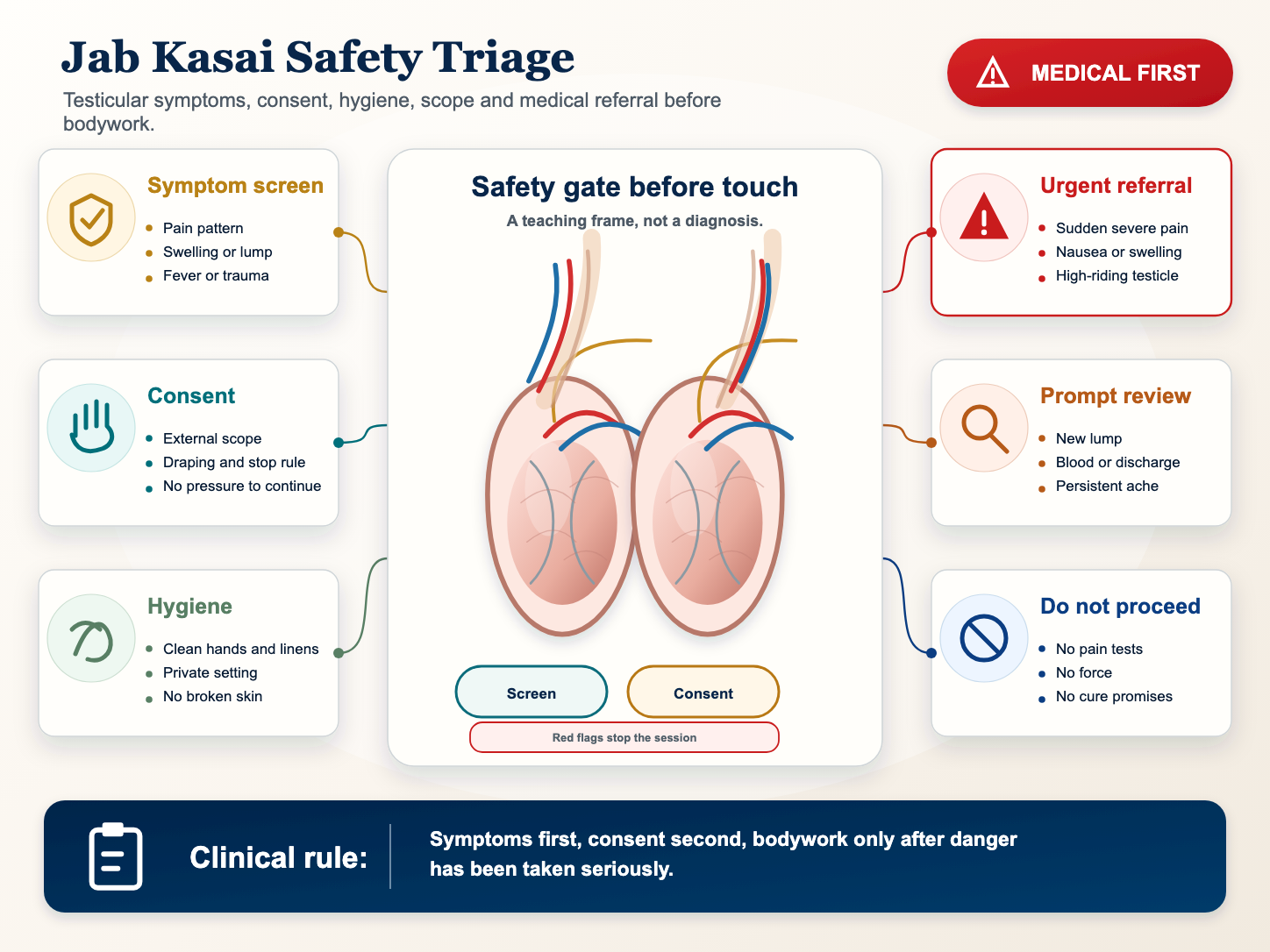
This matters especially for sudden pain. Some testicular conditions are time-sensitive. A reader should never be encouraged to wait, stretch, massage or test tolerance when the pattern suggests urgent assessment. The safest editorial rule is simple: symptoms first, claims second. If there is new pain, swelling, a lump, fever, discharge, trauma, nausea or a testicle sitting differently than usual, the next step is medical care, not bodywork.
The red flags that change the decision
Red flags are not rare legal footnotes. They are the filter that decides whether this conversation should continue at all. Sudden severe testicular pain should be treated as urgent, especially when it comes with nausea, vomiting, swelling, abdominal pain, fever or a high-riding testicle. A new lump, heaviness that does not settle, persistent ache, visible swelling, skin changes, blood in urine or semen, urinary burning, recent injury or suspected infection also deserves qualified assessment.
A serious practitioner should not try to talk a client out of that concern. The safer response is referral. That can feel frustrating when the client hoped for a relaxing session, but referral protects both people. It respects the fact that hands cannot rule out torsion, infection, cancer, hernia, trauma or other medical causes. It also makes the practice more credible because it shows that scope is understood.
- Urgent: sudden severe pain, nausea, vomiting, swelling, fever or a testicle that appears higher than usual.
- Prompt medical review: new lump, persistent heaviness, repeated pain, urinary symptoms, blood, discharge or recent trauma.
- Do not massage: any acute, unexplained, worsening or infection-like pattern.
Consent has to be specific
Consent is often discussed in general words, but sensitive male pelvic work needs specific words. The client should know which areas are included, which areas are excluded, whether touch is external only, how draping works, what hygiene steps are used, what pressure range is acceptable, what language will be used and how to stop. Consent should also be reversible. A client can agree, become uncomfortable and stop without explaining or negotiating.
Specific consent protects dignity. It also protects the practitioner from drifting into a vague session where the client is unsure what is happening. The most professional version is plain and calm: this is the scope, this is the purpose, these are the contraindications, this is how we stop, and these symptoms mean we do not proceed. A practitioner who cannot explain these details should not be trusted with sensitive anatomy.
Hygiene is part of the treatment boundary
Hygiene is not only about clean linens. It includes hand washing, nails, gloves when appropriate, clean draping, disinfected surfaces, fresh towels, no shared oils in contaminated containers, and no contact with broken skin or infection signs. It also includes privacy and confidentiality. A session involving intimate health language should not happen in a room where other people can enter or overhear without permission.
A clean setting does not make an unsafe indication safe. It simply means that one basic requirement has been met. Hygiene cannot compensate for poor triage, coercive marketing or a practitioner who makes medical promises. In sensitive work, the safety standard is cumulative: consent plus hygiene plus scope plus contraindications plus referral. Missing one of those pieces should pause the session.
Traditional language is not a medical diagnosis
Jab Kasai may be described online with terms such as circulation, energy, vitality, blocked pathways or male power. These words may belong to cultural or wellbeing language, but they should not be converted into medical conclusions. A reader should be able to appreciate traditional context while still asking what is actually known. Does the claim refer to relaxation, body awareness, muscle tension, stress reduction or a measurable condition? Is the outcome subjective comfort, or is someone promising to treat infertility, erectile dysfunction, prostatitis or low testosterone?
The difference is important. A traditional practice can be meaningful without being a cure. It may help some people feel more connected to the body, calmer or more aware of pelvic tension. That is not the same as proving an effect on sperm parameters, hormone levels, infection, vascular function or chronic disease. The more medical the claim, the higher the evidence standard should be.
Why pain is not proof of effectiveness
Some manual traditions use intensity as a sign that the work is deep. That idea is risky around the testicles and pelvic nerves. Pain is not proof that a blockage is releasing. Pain may mean the pressure is wrong, the tissue is irritated, the client is guarding, or a medical problem is present. A professional should not ask a client to endure pain to prove commitment.
Comfort levels can vary, but the rule should be conservative: no force, no surprise, no humiliation, no pressure to continue. If pain appears, the session should stop and the situation should be reassessed. If pain is sharp, sudden, one-sided, associated with swelling, nausea, fever or urinary symptoms, it belongs in a medical pathway. Repeating a painful technique is not a responsible test.
The practitioner selection test
Before booking any sensitive bodywork, ask boring practical questions. What training do you have? What symptoms do you refuse to work with? How is consent documented? What is the draping protocol? What hygiene steps are used? What areas are outside scope? What happens if I feel pain or want to stop? When do you refer to a doctor? A serious practitioner should answer without irritation.
The answers matter more than the marketing. Be cautious with anyone who promises to cure erectile dysfunction, prostatitis, infertility, trauma or low libido. Be cautious with secrecy, pressure, vague spiritual authority, refusal to explain touch, dismissal of pain, or sexualized framing of health concerns. A high-quality practitioner knows that limits are part of professionalism.
What to record before deciding
A reader who is unsure should write a short symptom record before booking anything. The record can include when the concern started, whether it is pain or curiosity, whether the sensation is one-sided or both-sided, whether swelling or a lump is present, whether urination has changed, whether fever or discharge exists, and whether there was recent injury, cycling, heavy lifting or sexual activity. This record is not meant to create anxiety. It separates ordinary interest from health information that should be checked.
The same record can be brought to a doctor, urologist or physiotherapist if needed. It is often easier to hand over notes than to improvise a sensitive explanation under pressure. The notes also make it harder for a practitioner to minimize red flags. If the written pattern contains sudden pain, swelling, fever, urinary symptoms, trauma or a new lump, the decision has already changed. The session should wait.
Aftercare should not become diagnosis
Aftercare language should stay modest. It is reasonable to advise hydration, rest, gentle observation and avoiding pressure if the person feels sensitive after any bodywork. It is not reasonable to interpret soreness as detox, healing crisis or proof that a deep blockage was released. Those explanations can hide harm and discourage people from seeking help when symptoms persist.
A useful aftercare rule is time and trend. Mild general soreness should settle, not intensify. New swelling, sharp pain, bruising, fever, urinary burning, blood or symptoms that worsen after touch should be treated as a reason to stop and seek qualified advice. The practitioner should welcome that boundary. Follow-up should never pressure the client into another session to fix a problem caused by the first one.
A simple go or stop checklist
A checklist helps remove pressure from the moment. If the client is curious, has no red flags, understands the scope, can stop at any time, and the practitioner can explain hygiene and referral rules, the conversation can remain in the wellbeing category. If any of those conditions are missing, the safest answer is to pause. A pause is not failure. It is how sensitive work stays professional.
The checklist should be repeated when circumstances change. A client who was healthy last month may now have pain. A practitioner who uses good consent language may still drift into medical promises. A room that looks clean may still lack privacy. Safety is not a one-time permission slip. It is a sequence of decisions before, during and after the session.
- Go only when symptoms are non-urgent, scope is clear, consent is specific and hygiene is visible.
- Pause when the client feels pressured, confused, embarrassed to ask questions or unsure how to stop.
- Refer when pain, swelling, fever, urinary symptoms, trauma or a new lump enters the picture.
What a safe educational conclusion looks like
A safe conclusion does not say that everyone should avoid traditional bodywork forever. It says that sensitive bodywork belongs behind a set of gates. First, screen symptoms. Second, explain scope. Third, obtain specific and reversible consent. Fourth, maintain hygiene and privacy. Fifth, avoid medical promises. Sixth, refer when red flags or persistent symptoms appear.
For readers, the practical takeaway is simple. If the interest is cultural learning, relaxation or body awareness, keep the expectations modest and the boundaries clear. If the concern is pain, swelling, erection change, urinary symptoms, fertility, a lump or fear that something is wrong, start with a qualified clinician. Bodywork can be a wellbeing choice only after danger has been taken seriously.
Do not use Jab Kasai, testicular massage or any manual practice to investigate sudden pain, swelling, fever, trauma, a new lump or urinary symptoms. Those patterns need medical assessment.