Medical schema
How to read this guide safely
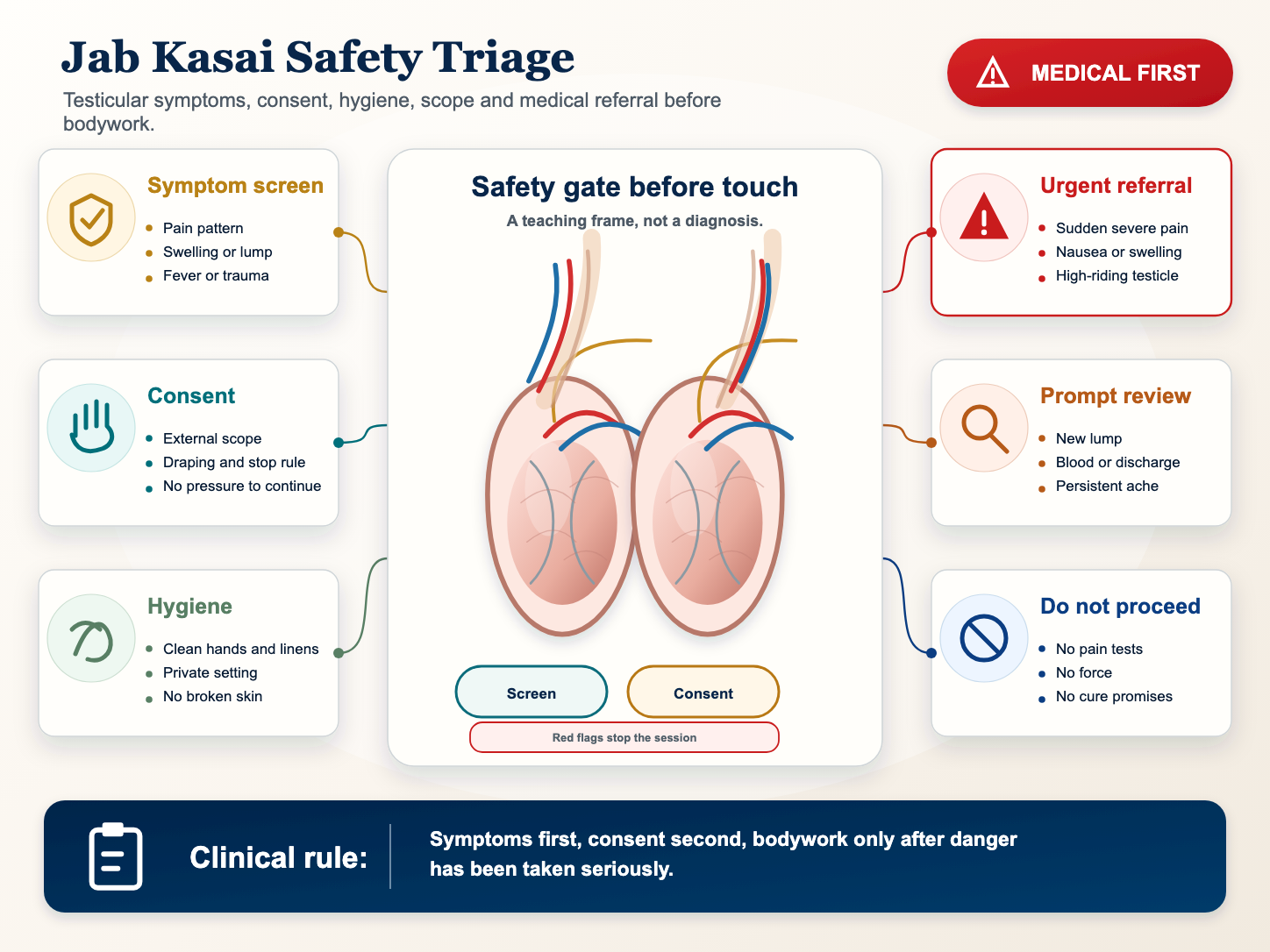
This visual map connects What Is Jab Kasai? to anatomy, symptom triage, professional care and the limits of bodywork claims.
- 01
Observe the pattern
Clarify whether the goal is comfort, cultural practice, sexual wellbeing or a medical claim.
- 02
Check red flags
Sudden severe testicular pain, swelling, nausea, trauma or a new lump is not a massage topic.
- 03
Choose the care path
Urgent care, urology, ultrasound or fertility assessment may be needed depending on the pattern.
- 04
Keep clear boundaries
Consent, hygiene, pressure limits, contraindications and referral rules must be explicit.
What this page covers
Definition, naming, cultural context and careful modern framing of Jab Kasai as a Thai male pelvic wellbeing tradition.
Key points
- Jab Kasai appears online as a Thai male pelvic and testicular bodywork tradition, but published medical evidence is limited.
- It should be described as cultural wellbeing or traditional bodywork, not as a proven cure.
- A serious practitioner should explain consent, boundaries, hygiene, contraindications and referral to healthcare when symptoms suggest disease.
A tradition that needs careful framing
Jab Kasai is best introduced with restraint: as a Thai male pelvic and testicular wellbeing tradition described online in different ways, not as a proven medical cure. That distinction protects the reader, the practitioner and the cultural context.
A serious explanation should include what the term may mean, why naming varies and why safety boundaries matter before any intimate or sensitive bodywork is discussed.
- Separate cultural vocabulary from medical diagnosis.
- Look for consent, hygiene, draping and referral policies.
- Be cautious with fertility, erection or prostatitis cure claims.
Definition in plain language
Jab Kasai is usually described online as a Thai male bodywork tradition focused on the lower abdomen, pelvis, groin and sometimes the testicles. The spelling and the exact method vary from one school or practitioner to another, so the most responsible definition is broad rather than absolute. It is a cultural and wellbeing term before it is a medical term. That matters because many internet descriptions move too quickly from traditional language into promises about fertility, testosterone, erections or prostate disease.
A careful definition should say what the subject is without pretending that every claim is proven. Jab Kasai may be presented as a way to support relaxation, body awareness, a sense of pelvic ease or a traditional understanding of energy flow. Those descriptions can be meaningful in a cultural setting. They should not be rewritten as evidence that a manual technique can diagnose disease, reverse infertility, change hormone levels or treat a vascular or neurological condition.
The word "definition" also needs a boundary. A page that defines Jab Kasai should not become an eroticized description of intimate contact. Sensitive anatomy can be discussed seriously, clinically and respectfully. The defining features should be informed consent, adult-only context, hygiene, clear scope, gentle pressure and the right to stop, not secrecy, pressure or sensational marketing.
- Use Jab Kasai as a traditional wellbeing and bodywork term, not as a diagnosis.
- Describe possible session areas without promising a medical result.
- Keep consent, hygiene, draping and contraindications visible from the start.
Traditional language versus medical language
Traditional bodywork systems often use words such as energy, flow, release, heat, stagnation, vitality or blocked pathways. Those words can be part of a practitioner culture, a teaching lineage or a client experience. Modern medicine uses a different vocabulary: blood vessels, nerves, hormones, sperm parameters, inflammation, infection, tissue injury, pain mechanisms and psychological context. The two vocabularies should not be blended carelessly.
For example, a person may feel warmer, calmer or more aware of pelvic tension after gentle bodywork. That subjective experience is valid as an experience. It does not prove that sperm count improved, testosterone increased, blood flow changed in a clinically meaningful way or an infection resolved. This site therefore treats traditional language as cultural and experiential unless a claim can be supported by medical evidence.
This distinction protects readers who arrive with real symptoms. If a man has sudden testicular pain, a new lump, swelling, fever, urinary retention, blood in urine, severe pelvic pain or persistent erection changes, the responsible next step is clinical assessment. Jab Kasai can be discussed as a tradition, but it should not delay urgent or necessary care.
What a serious page should include
A serious educational page about Jab Kasai should answer practical questions before it uses poetic language. What body areas might be involved? Is the work external only? How is consent obtained? How is draping handled? What hygiene standards are used? What symptoms mean the session should not happen? What claims are not being made? These questions are not obstacles to tradition; they make tradition safer to discuss in a modern setting.
The page should also explain that training quality varies. A beautiful website, spiritual language or confident practitioner biography does not prove competence. Readers should look for plain answers about scope, contraindications, referral to healthcare and professional boundaries. If a practitioner cannot explain what they will do, what they will not do and when they would refuse or postpone a session, the client does not have enough information to consent.
The safest framing is modest. Jab Kasai can be introduced as an adult, consent-based, culturally influenced bodywork topic related to male pelvic wellbeing. It should not be sold as a cure for erectile dysfunction, prostatitis, infertility, chronic pelvic pain, varicocele, low testosterone or any condition that requires diagnosis.
- A definition page should include safety exclusions, not only benefits.
- External and internal techniques should never be blurred.
- Medical symptoms should be routed to qualified clinicians.
References and further reading
The references below are not proof that Jab Kasai itself is a standardized medical treatment. They are included to clarify the broader standards used on this site: traditional practices should be discussed with safety and regulation in mind, while fertility and urgent testicular symptoms belong to evidence-based healthcare pathways.
- World Health Organization - Traditional medicine strategy 2014-2023
- AUA/ASRM guideline - Diagnosis and treatment of infertility in men
- NICE guideline NG257 - Fertility problems: assessment and treatment
- Guy's and St Thomas' NHS - Testicular torsion surgery overview
Reader checklist before acting
Before acting on any page about Jab Kasai as a Thai male pelvic wellbeing tradition, the reader should slow the decision down. The safest question is not "does this sound attractive?" but "do I understand what is being offered, what is excluded and what problem I am actually trying to solve?" This is especially important for someone trying to understand the term before comparing practitioners or claims. A clear decision starts with separating curiosity, discomfort, symptoms, cultural interest and medical concern.
The second question is whether the concern belongs in a bodywork setting at all. If the issue includes testicular pain, pelvic pain, fertility questions, erection changes, urinary symptoms or prostate concerns, the page should guide the reader toward qualified healthcare rather than a wellness appointment. That is not an anti-tradition position. It is a boundary that keeps traditional or intimate bodywork from being used as a substitute for diagnosis, urgent care or evidence-based treatment.
The third question is whether the practitioner can describe limits as well as benefits. A serious practitioner can say when they would refuse a session, when they would refer out, which body areas are outside scope, how consent is maintained and how hygiene is handled. A practitioner who can only describe transformation, release or vitality is leaving the most important safety information out of the conversation.
- Can the session scope be explained in ordinary anatomical language?
- Are red flags and contraindications visible before booking?
- Is the claim about relaxation and body awareness, or about treating a medical condition?
- Does the reader know what to do if pain, distress or boundary confusion appears?
How JABKASAI frames this topic
JABKASAI uses an editorial rule across sensitive subjects: the closer a claim gets to medicine, the more evidence it needs. Cultural meaning, tradition, ritual language, relaxation and personal experience can be discussed respectfully. Claims about fertility, testosterone, infection, torsion, cancer, erectile dysfunction, chronic pelvic pain, prostate disease or hormone change require a different standard. They need qualified assessment, measurable outcomes and a willingness to say "we do not know" when evidence is limited.
This framing is also designed to prevent shame. Many men delay asking questions because the anatomy feels private or embarrassing. A good educational page should make the subject easier to name without turning vulnerability into sensational content. That means plain words, non-erotic tone, adult-only framing, careful images, medical caution and no pressure to book a session as the answer to every concern.
The final standard is practical usefulness. After reading, a person should be able to ask better questions, recognize warning signs, compare practitioner language more safely and understand when a clinician, urologist, fertility specialist, pelvic floor physiotherapist or mental health professional may be the better next step. If the page does that, it has served the reader even if they never book bodywork.
- Tradition is presented as tradition, not as automatic proof.
- Wellbeing language is allowed, but cure language is challenged.
- Sensitive anatomy is discussed professionally and without erotic marketing.
- The reader is always allowed to choose medical care, a second opinion or no session.
Deep-dive Jab Kasai subpages
This section expands the Jab Kasai topic into focused long-form guides. Each guide treats the subject as tradition, culture and wellbeing language first, with medical claims handled cautiously and red flags kept visible.
Practical context
Notice timing, intensity, triggers and what changes the situation. Pain, urinary changes, medication, stress, injury, recent bodywork and general health can all affect how a symptom or concern should be understood.
Questions to ask next
- Which signs would make this urgent rather than routine?
- What information should be recorded before speaking with a clinician or qualified practitioner?
- Which claims are supported by evidence, and which should be treated as cultural or wellbeing language only?
How to use this information
Use this guide to clarify language, prepare better questions and understand boundaries. It is not a diagnosis and it is not a treatment plan. When symptoms are new, intense, persistent or worrying, the right next step is a qualified clinician.
Editorial position
JABKASAI separates cultural wellbeing traditions from medical evidence. Where evidence is limited, the page says so plainly and avoids promises of cure.