
Surviving prostate cancer is not the same as feeling finished with prostate cancer. For many men, the next chapter is quieter but still demanding: erections feel different, urinary control is unpredictable, confidence changes, and the body becomes a place that needs careful listening rather than bravado.
A new 2026 survivorship study makes that reality harder to ignore. It looked at treatment patterns for erectile dysfunction and urinary incontinence after therapy for clinically localized prostate cancer, and it found that these problems are common while more invasive interventions remain uncommon. For JABKASAI readers, the useful lesson is not panic. It is preparation: know what belongs in a medical conversation, what can be supported by rehabilitation, and where traditional bodywork must stay inside a cautious, non-medical role.
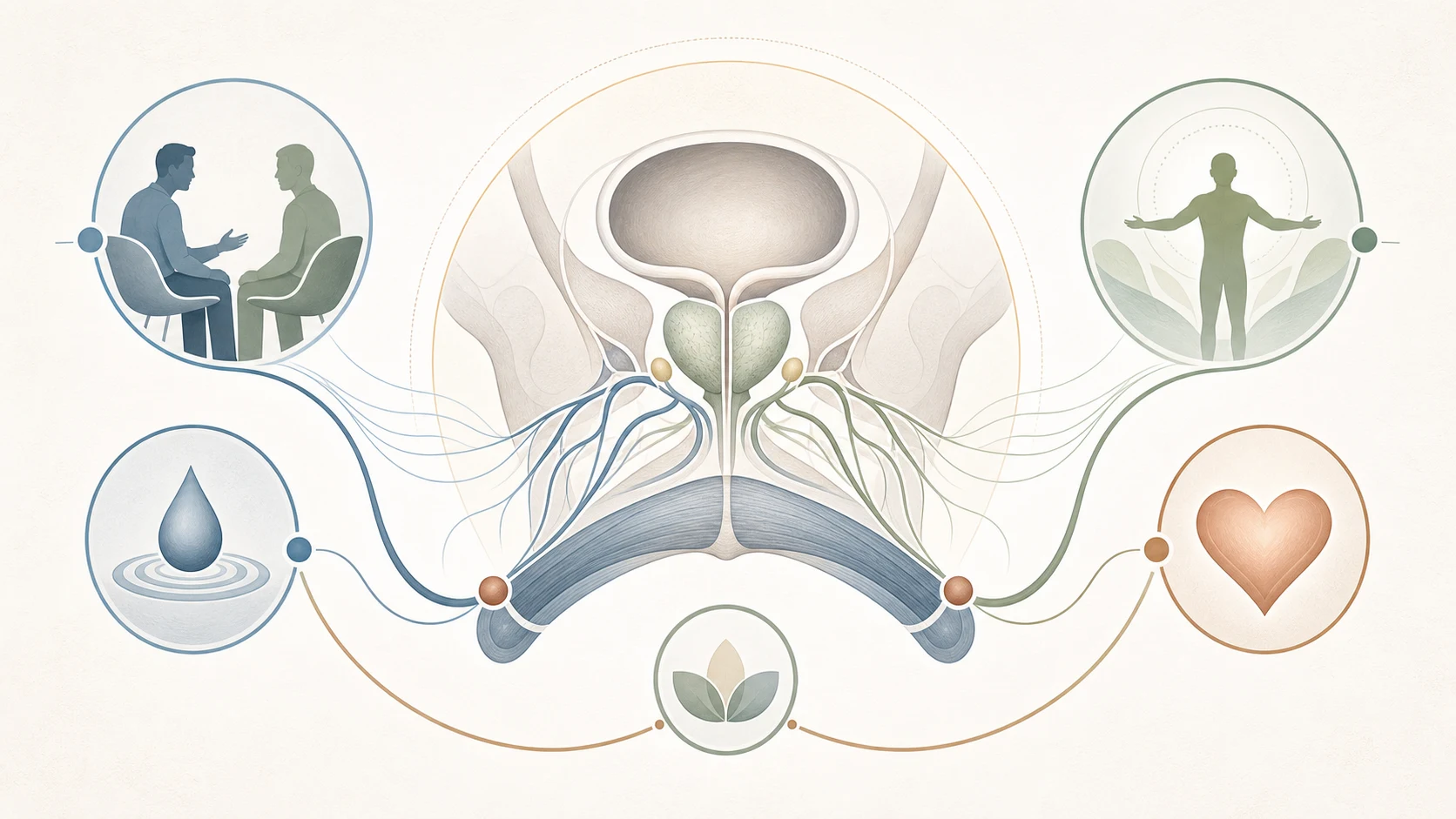
What the New Study Adds
The selected study, indexed by Europe PMC on July 21, 2026, focused on men diagnosed with clinically localized prostate cancer between 2015 and 2024. The record describes a large United States cohort drawn from EPIC Cosmos, with men treated by radical prostatectomy, radiation therapy, or combinations that could include hormone therapy.
Its headline value is practical. Among 90,161 men, the abstract reports that 39.29% developed erectile dysfunction and 20.68% had urinary incontinence after prostate cancer treatment. Medical erectile dysfunction treatment was recorded in 33.35%, while penile prosthesis surgery and urinary incontinence surgery were much less common.
Those numbers do not tell any one reader what will happen to him. They do show that sexual and urinary changes are not rare private failures. They are predictable survivorship issues that deserve early, direct and culturally sensitive discussion.
- The study is recent and directly male-Gesundheit focused.
- The angle is survivorship care, not a claim about one treatment being best.
Why Erektionen Can Change After Prostata Cancer Versorgung
Erektion Gesundheit depends on blood vessels, nerves, hormones, mood, medication context and Beckenboden coordination. The JABKASAI Erektile Dysfunktion: Medizinische Karte already frames ED as a signal to understand, not a character flaw.
NCI explains that pelvic radiation can affect sexual function when blood vessels or nerves are damaged. It also notes that hormone therapy can lower testosterone levels and sexual drive. Surgery for prostate and other pelvic cancers may affect nerves that help men get and keep an erection.
That matters because a man may describe only one symptom, such as weaker erections, while the cause may involve several overlapping factors. Cancer treatment, age, diabetes, cardiovascular health, smoking history, medications, anxiety and relationship stress can all change the same visible outcome.
The careful move is to bring the pattern to a clinician. Timing, treatment history, morning erections, libido, orgasm changes, penile curvature, pain, medication use and cardiovascular risk all help separate ordinary recovery from a problem needing focused care.
Why Leakage and Harnbezogen Symptome Need Their Own Track
Urinary symptoms after prostate cancer treatment can include leakage, urgency, frequency, burning, weak stream, difficulty emptying or blood in urine. Some are expected during recovery; others need prompt review. JABKASAI keeps a separate Rote Flaggen im Urin bei Männern guide because harnbezogen signs should not be folded into a massage or wellness explanation.
NCI lists pelvic radiation and prostatectomy among cancer treatments that can cause urinary or bladder problems. It also advises patients to ask their health care team which symptoms should trigger a call, especially when fever, pain, urinary retention or infection-like signs appear.
The 2024 AUA guideline update on incontinence after prostate treatment reinforces the idea that continence belongs in clinical planning, not just after-the-fact embarrassment. Men should be informed about known factors that may affect continence before localized prostate cancer treatment, then reassessed when symptoms persist or interfere with daily life.
A practical self-observation log can help: how many pads per day, whether leakage happens with coughing or lifting, whether urgency comes before leakage, whether nighttime urination is rising, whether there is burning or blood, and whether symptoms are improving, stable or worsening.
The Survivorship Gap Is Often a Conversation Gap
The 2026 study does not merely count symptoms. It asks who receives treatment for erectile dysfunction or urinary incontinence after prostate cancer care. Its abstract reports that socioeconomic, racial and clinical factors were associated with treatment patterns, which means access and communication may shape recovery options.
This is a sensitive point. A man may assume nothing can be done, may avoid sexual topics with a clinician, may feel that leakage is too humiliating to name, or may think quality-of-life concerns are less legitimate than cancer control. Those assumptions can leave treatable problems unaddressed.
A better script is plain: since treatment, my erections have changed; I leak when I stand or cough; I avoid intimacy because I am worried about urine; I want to know which options are safe for my cancer history. Direct language gives the clinician something to work with.
Partners can be part of that conversation when the man wants them involved. Sexual recovery is rarely only mechanical. Anxiety, avoidance, body image, dryness of orgasm, changed sensation and fear of recurrence can all sit in the room.
- Ask early rather than waiting until frustration hardens.
- Use concrete symptom examples instead of apologizing.
- Request referral when the first answer is too vague.
What Longer-Term Outcomes Teach
A 2024 JAMA CEASAR analysis followed 2,445 men with localized prostate cancer for a median of 9.5 years. It compared patient-reported sexual, urinary, bowel and hormone function after common treatment approaches, using the EPIC-26 quality-of-life instrument.
The useful lesson is not that one path is perfect. NIH's summary of the study emphasized that many men with localized prostate cancer survive 15 years or more, and that similar survival time horizons make adverse effects important in treatment decisions.
For favorable-prognosis disease in the JAMA report, radical prostatectomy was associated with worse urinary incontinence scores at 10 years compared with active surveillance, external beam radiation or brachytherapy. Sexual function differences were more prominent earlier after treatment and less distinct by the 10-year mark.
For readers, the practical implication is to treat function as a longitudinal issue. A six-week snapshot, a six-month frustration and a ten-year quality-of-life pattern are different clinical questions. Good survivorship care keeps checking in.
Where Beckenboden Versorgung Fits
The Männlicher Beckenboden is not only a fitness idea. In men, it supports continence, sexual function, bowel coordination and pelvic stability, which is why pelvic floor rehabilitation may be part of prostate cancer recovery conversations.
Pelvic floor care should be individualized. Some men need strengthening, some need relaxation and coordination, and some need evaluation for pain, scar sensitivity, nerve symptoms or overactivity. More force is not always better, especially when the pelvis is guarding after treatment or stress.
A pelvic floor physical therapist or urologist can help decide whether exercises, bladder training, breathing, graded activity, medications, devices or surgical options belong in the plan. This is very different from a generic promise that any manual therapy can fix leakage or erections.
For JABKASAI, the message is narrow and honest: traditional bodywork can sometimes support relaxation, body awareness and respectful reconnection with the body, but it cannot diagnose post-treatment incontinence, restore nerves, prescribe ED medication or replace cancer follow-up.
Warnzeichen That Should Not Wait
After prostate cancer treatment, urgent symptoms need medical contact rather than online reassurance. Fever, chills, severe pelvic pain, inability to urinate, new blood in urine, worsening back or hip pain, chest pain, sudden leg swelling, new neurological symptoms or signs of infection should be assessed promptly.
Painful urination, cloudy or red urine, back or abdominal pain and difficulty urinating can point toward urinary infection or retention. NCI warns that urinary tract infection in people being treated for cancer can become serious and may need immediate medical care.
Sexual symptoms also have red flags. Sudden severe penile pain, traumatic injury, prolonged erection, new curvature with pain, marked loss of genital sensation, or ED accompanied by chest pain or exertional symptoms should be discussed medically. The goal is not alarm; it is correct routing.
A bodywork appointment should be postponed when symptoms suggest infection, acute urinary retention, unexplained bleeding, uncontrolled pain, active cancer-treatment complications or unclear medical status. Consent also includes the right to stop, redirect or avoid any intimate-area technique.
How to Prepare for the Appointment
Men often get better help when they bring a short, specific record. Write down the prostate cancer treatment type, treatment dates, current medications, hormone therapy history, urinary pattern, pad use, erection changes, pain pattern and what has improved or worsened.
Useful questions include: which symptoms are expected for my treatment timeline; do I need pelvic floor physical therapy; are ED medicines safe with my heart history and other prescriptions; when should leakage be reassessed; and what options exist if conservative care does not help.
It can also help to ask who owns the next step. Oncology may watch cancer status, urology may handle erections and urinary leakage, pelvic floor therapy may support function, and mental health or sex therapy may support intimacy and confidence. Survivorship works best when the handoffs are explicit.
For men in Thailand or traveling for wellness care, the same rule applies: supportive touch should be transparent, adult, consent-based and non-medical. Any practitioner who promises to cure prostate cancer, reverse radiation injury, restore erections guaranteed, or replace a urologist is crossing a safety line.
This article is educational only. New, severe, persistent or worsening urinary, sexual, pelvic or cancer-related symptoms should be assessed by qualified oncology, urology or pelvic floor clinicians; Jab Kasai and bodywork do not replace diagnosis, prescribed treatment or cancer follow-up.
Conclusion
The most useful survivorship mindset is neither denial nor panic. Erectile dysfunction and urinary leakage after localized prostate cancer treatment are common enough to deserve normal language, careful tracking and timely clinical support.
For JABKASAI readers, the boundary is clear. Respectful bodywork may support relaxation and body awareness for medically stable adults, but prostate cancer survivorship belongs first to evidence-based oncology, urology, pelvic floor rehabilitation and honest conversations about quality of life.
Frequently asked questions
Is erectile dysfunction after Prostata cancer treatment always permanent?
No. Some changes improve with time, some persist, and some respond to medical or rehabilitative options. The pattern depends on treatment type, nerve and vascular factors, hormone therapy, age, baseline erection health, medications and other health conditions.
A clinician can help distinguish expected recovery from a problem needing treatment. Do not assume silence means there are no options.
Can Beckenboden exercises fix harnbezogen leakage after Prostata treatment?
Pelvic floor muscle training may help some men recover continence or improve control, especially when it is tailored and supervised. It is not the only option, and persistent or severe leakage should be reviewed by a urologist or pelvic floor professional.
The key is assessment. Some men need strengthening, while others need coordination, relaxation, bladder strategies or surgical discussion.
Can Jab Kasai or massage treat post-Prostata-cancer erectile dysfunction?
No traditional bodywork should be presented as a treatment for prostate cancer, nerve injury, vascular erectile dysfunction or urinary incontinence. Jab Kasai can only sit in a supportive, non-medical frame when a client is medically stable, fully consenting and not using bodywork instead of clinical care.
If Symptome are new, severe, worsening or unexplained, medizinisch review comes first.
What should I ask my doctor if I feel embarrassed?
Use concrete language: since treatment I leak urine when I cough, I avoid sex because erections are unreliable, or I am worried about orgasm changes. Ask which symptoms are expected, which are treatable, and which specialist should help next.
Embarrassment is common, but clinicians can only respond to what is named.
Verwandte JABKASAI-Führer
Themen
Quellen überprüft
- Prostata cancer survivorship in modern times — Europe PMC / Journal of Cancer Survivorship
- Sexuell Gesundheit Issues in Men with Cancer — National Cancer Institute
- Harnbezogen and Bladder Problems — National Cancer Institute
- Funktional Outcomes After Localized Prostata Cancer Behandlung — JAMA
- Comparing side effects after Prostata cancer treatment — National Institutes of Gesundheit
- Guidelines - Published Guidelines — American Urological Association