
Medical schema
How to read this guide safely
This visual map connects Jab Kasai vs Karsai vs Prostate Massage to anatomy, symptom triage, professional care and the limits of bodywork claims.
- 01
Observe the pattern
Clarify whether the goal is comfort, cultural practice, sexual wellbeing or a medical claim.
- 02
Check red flags
Sudden severe testicular pain, swelling, nausea, trauma or a new lump is not a massage topic.
- 03
Choose the care path
Urgent care, urology, ultrasound or fertility assessment may be needed depending on the pattern.
- 04
Keep clear boundaries
Consent, hygiene, pressure limits, contraindications and referral rules must be explicit.
What this page covers
A terminology guide comparing Thai naming, testicular bodywork, pelvic bodywork and prostate massage.
Key points
- Names vary online: Jab Kasai, Jap Kasai and Karsai may be used differently by schools and practitioners.
- Testicular or pelvic bodywork is not the same as prostate massage.
- Medical claims should be separated from cultural language and practitioner marketing.
Why terminology matters
Similar names can hide very different practices. Jab Kasai, Jap Kasai, Karsai and prostate massage may be used loosely in marketing, but the anatomy, boundaries, intention and risk profile are not identical.
Clear terminology helps readers ask better questions before booking training, reading claims or comparing practitioners. It also prevents a cultural bodywork term from being confused with a medical or internal technique.
- Ask exactly which body areas are involved and which are not.
- Clarify whether the session is external, internal, educational or therapeutic.
- Do not accept vague naming as a substitute for informed consent.
Why similar names cause confusion
Jab Kasai, Jap Kasai, Karsai and prostate massage are often placed close together online, but they should not be treated as interchangeable words. Spelling variations may come from transliteration, school branding, practitioner marketing or attempts to describe Thai-language ideas with Roman letters. A reader can easily assume that all terms point to the same technique, when in practice they may refer to different body areas, different intentions and different boundaries.
The most important difference is not spelling; it is scope. Some descriptions emphasize external male pelvic and testicular bodywork. Others use Karsai as a broader pelvic or genital tradition. Prostate massage, by contrast, is commonly understood as work involving the prostate, and may imply internal contact in some contexts. That distinction changes consent, risk, hygiene, training requirements and medical caution.
A responsible practitioner should not hide behind a name. If a client asks what Jab Kasai means in that specific setting, the answer should be concrete: which areas may be touched, which are never touched, whether the work is external only, what draping is used, what symptoms are contraindications and whether any medical benefit is being claimed.
- A name is not consent; the actual technique must be explained.
- External testicular or pelvic work is not the same category as prostate massage.
- Marketing language should never replace anatomy, boundaries and safety.
Jab Kasai and Jap Kasai
The difference between Jab Kasai and Jap Kasai is usually a naming and spelling issue rather than a reliable clinical distinction. Online sources may use one or the other depending on transliteration, teacher lineage or search behavior. Because there is no widely accepted medical standard for the term, the reader should avoid assuming that one spelling guarantees a safer or more authentic practice.
The safer question is practical: what is being offered? A practitioner might use the term for lower abdominal massage, groin-adjacent work, testicular work, pelvic relaxation, energetic language or a mixed session. Another practitioner might use the same spelling differently. This is why the page should teach readers how to ask for scope, boundaries and contraindications rather than memorizing a single spelling rule.
To avoid confusion, it is useful to mention both spellings, but the page should not create false precision. The safest wording is simple: spelling varies, and the ethical standard is transparency. A serious explanation names the limits of terminology rather than turning a spelling difference into a mystical claim.
Karsai and pelvic bodywork
Karsai is often used in wellness circles to describe Thai-influenced work around the lower abdomen, pelvis and genital region. Some descriptions connect it with circulation, energy lines or reproductive vitality. Those themes may belong to a traditional teaching context, but they are not automatically medical claims. The body area is sensitive, and the claims made about it must be handled carefully.
When a practitioner says Karsai, the reader should ask whether the session is educational, relaxation-focused, external bodywork, genital bodywork or something else. The answer should be given before the session, not discovered during it. Boundaries should include draping, communication, pressure level, areas excluded, stop signals and how discomfort is handled.
Karsai language can also be used too broadly in marketing. A page should not imply that Karsai treats varicocele, infertility, prostatitis, erectile dysfunction or chronic pelvic pain unless it can point to reliable evidence and a qualified clinical framework. Without that evidence, the honest category is traditional or wellbeing practice with safety limits.
- Ask for the practical definition used by that practitioner or school.
- Do not assume that a traditional word guarantees safe training.
- Watch for exaggerated claims about organs, hormones or fertility.
Prostate massage is a separate consent category
Prostate massage deserves separate discussion because it can involve the rectum, prostate region, infection risk, hygiene concerns and medical contraindications. Even when presented in a wellness context, it is not the same as general pelvic relaxation or external testicular work. A client who consented to Jab Kasai has not automatically consented to prostate work.
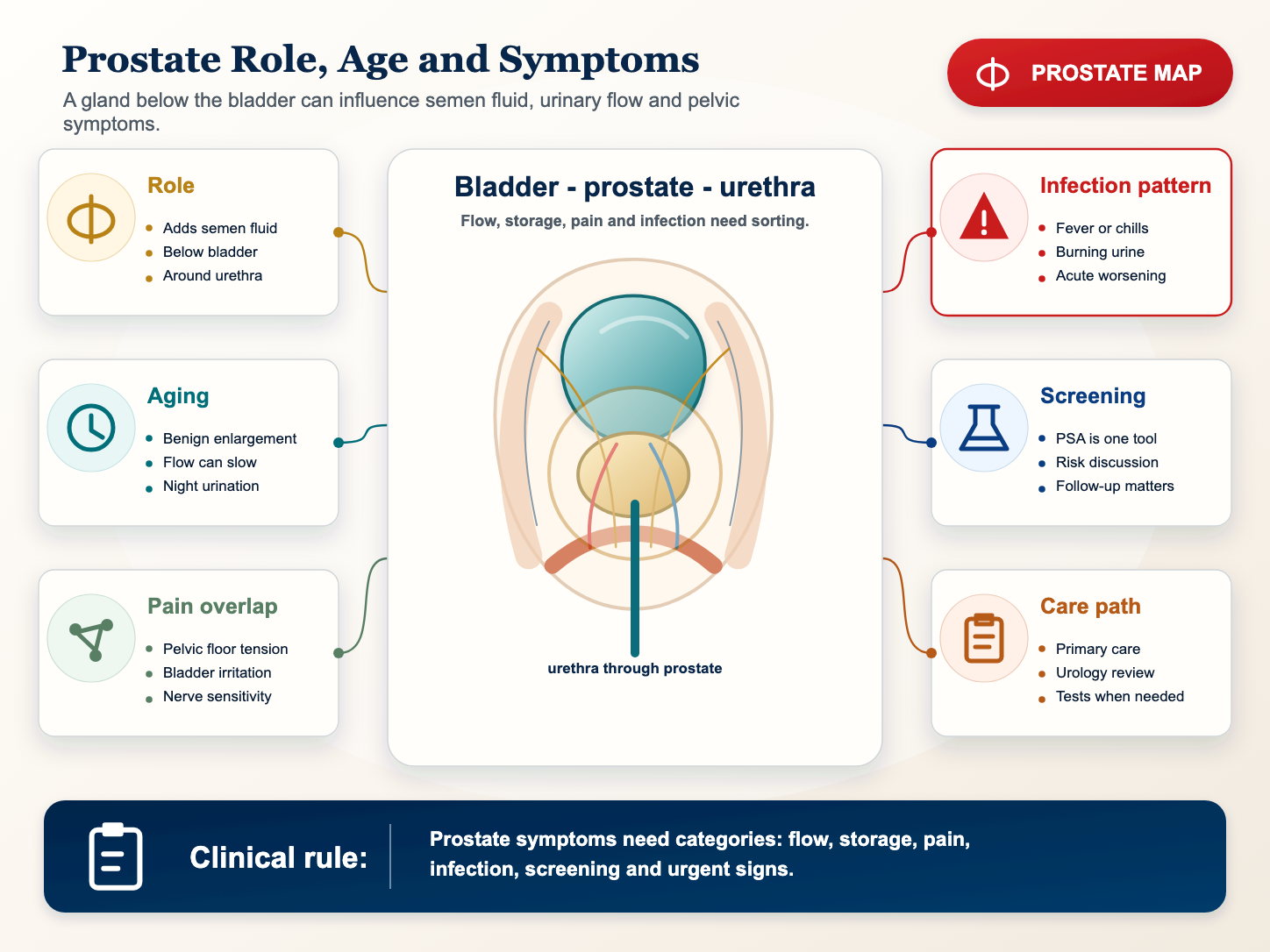
Medical symptoms around the prostate can be complex. Pain, urinary symptoms, ejaculation pain, fever or pelvic discomfort may involve infection, inflammation, pelvic floor tension, bladder conditions or other causes. Manual stimulation should not be used as a substitute for assessment when symptoms are persistent, severe or accompanied by red flags.
This is why the comparison page should be firm: similar labels found online do not collapse different techniques into one safe package. Each category requires its own explanation and consent. If a practitioner blurs the terms, pressures the client or implies that internal work is automatically included, that is a serious boundary problem.
References and further reading
These references support the editorial approach used here: traditional and complementary practices should be discussed with safety and regulation in mind, while fertility and urgent scrotal symptoms require medical pathways rather than terminology debates.
- World Health Organization - Traditional medicine strategy 2014-2023
- AUA/ASRM guideline - Diagnosis and treatment of infertility in men
- NICE guideline NG257 - Fertility problems: assessment and treatment
- Guy's and St Thomas' NHS - Testicular torsion surgery overview
Reader checklist before acting
Before acting on any page about Jab Kasai, Karsai and prostate massage terminology, the reader should slow the decision down. The safest question is not "does this sound attractive?" but "do I understand what is being offered, what is excluded and what problem I am actually trying to solve?" This is especially important for someone comparing similar names and trying to avoid a consent misunderstanding. A clear decision starts with separating curiosity, discomfort, symptoms, cultural interest and medical concern.
The second question is whether the concern belongs in a bodywork setting at all. If the issue includes pain, urinary change, prostate symptoms, infection signs, fertility concerns or any proposed internal technique, the page should guide the reader toward qualified healthcare rather than a wellness appointment. That is not an anti-tradition position. It is a boundary that keeps traditional or intimate bodywork from being used as a substitute for diagnosis, urgent care or evidence-based treatment.
The third question is whether the practitioner can describe limits as well as benefits. A serious practitioner can say when they would refuse a session, when they would refer out, which body areas are outside scope, how consent is maintained and how hygiene is handled. A practitioner who can only describe transformation, release or vitality is leaving the most important safety information out of the conversation.
- Can the session scope be explained in ordinary anatomical language?
- Are red flags and contraindications visible before booking?
- Is the claim about relaxation and body awareness, or about treating a medical condition?
- Does the reader know what to do if pain, distress or boundary confusion appears?
How JABKASAI frames this topic
JABKASAI uses an editorial rule across sensitive subjects: the closer a claim gets to medicine, the more evidence it needs. Cultural meaning, tradition, ritual language, relaxation and personal experience can be discussed respectfully. Claims about fertility, testosterone, infection, torsion, cancer, erectile dysfunction, chronic pelvic pain, prostate disease or hormone change require a different standard. They need qualified assessment, measurable outcomes and a willingness to say "we do not know" when evidence is limited.
This framing is also designed to prevent shame. Many men delay asking questions because the anatomy feels private or embarrassing. A good educational page should make the subject easier to name without turning vulnerability into sensational content. That means plain words, non-erotic tone, adult-only framing, careful images, medical caution and no pressure to book a session as the answer to every concern.
The final standard is practical usefulness. After reading, a person should be able to ask better questions, recognize warning signs, compare practitioner language more safely and understand when a clinician, urologist, fertility specialist, pelvic floor physiotherapist or mental health professional may be the better next step. If the page does that, it has served the reader even if they never book bodywork.
- Tradition is presented as tradition, not as automatic proof.
- Wellbeing language is allowed, but cure language is challenged.
- Sensitive anatomy is discussed professionally and without erotic marketing.
- The reader is always allowed to choose medical care, a second opinion or no session.
Practical context
Notice timing, intensity, triggers and what changes the situation. Pain, urinary changes, medication, stress, injury, recent bodywork and general health can all affect how a symptom or concern should be understood.
Questions to ask next
- Which signs would make this urgent rather than routine?
- What information should be recorded before speaking with a clinician or qualified practitioner?
- Which claims are supported by evidence, and which should be treated as cultural or wellbeing language only?
How to use this information
Use this guide to clarify language, prepare better questions and understand boundaries. It is not a diagnosis and it is not a treatment plan. When symptoms are new, intense, persistent or worrying, the right next step is a qualified clinician.
Editorial position
JABKASAI separates cultural wellbeing traditions from medical evidence. Where evidence is limited, the page says so plainly and avoids promises of cure.