
A new 2026 study on HIV and male fertility is easy to misread. The headline sounds direct: chronic HIV-related gene expression disrupted testicular and sperm function in a laboratory rat model. For a man living with HIV, or a man worried about HIV exposure, that can land as fear.
The safer reading is more useful. The study does not prove that every man with HIV is infertile. It does not say that bodywork, supplements, detox plans or sexual abstinence can fix sperm quality. It does show why reproductive health deserves a place in HIV care conversations, especially when a man wants future biological children or has symptoms that he has been quietly ignoring.
JABKASAI readers can use this as a prompt for better questions, not panic. 남성 불임의 기초 explains the broader 생식 능력 frame, while this article focuses on what HIV-specific evidence can and cannot tell men today.
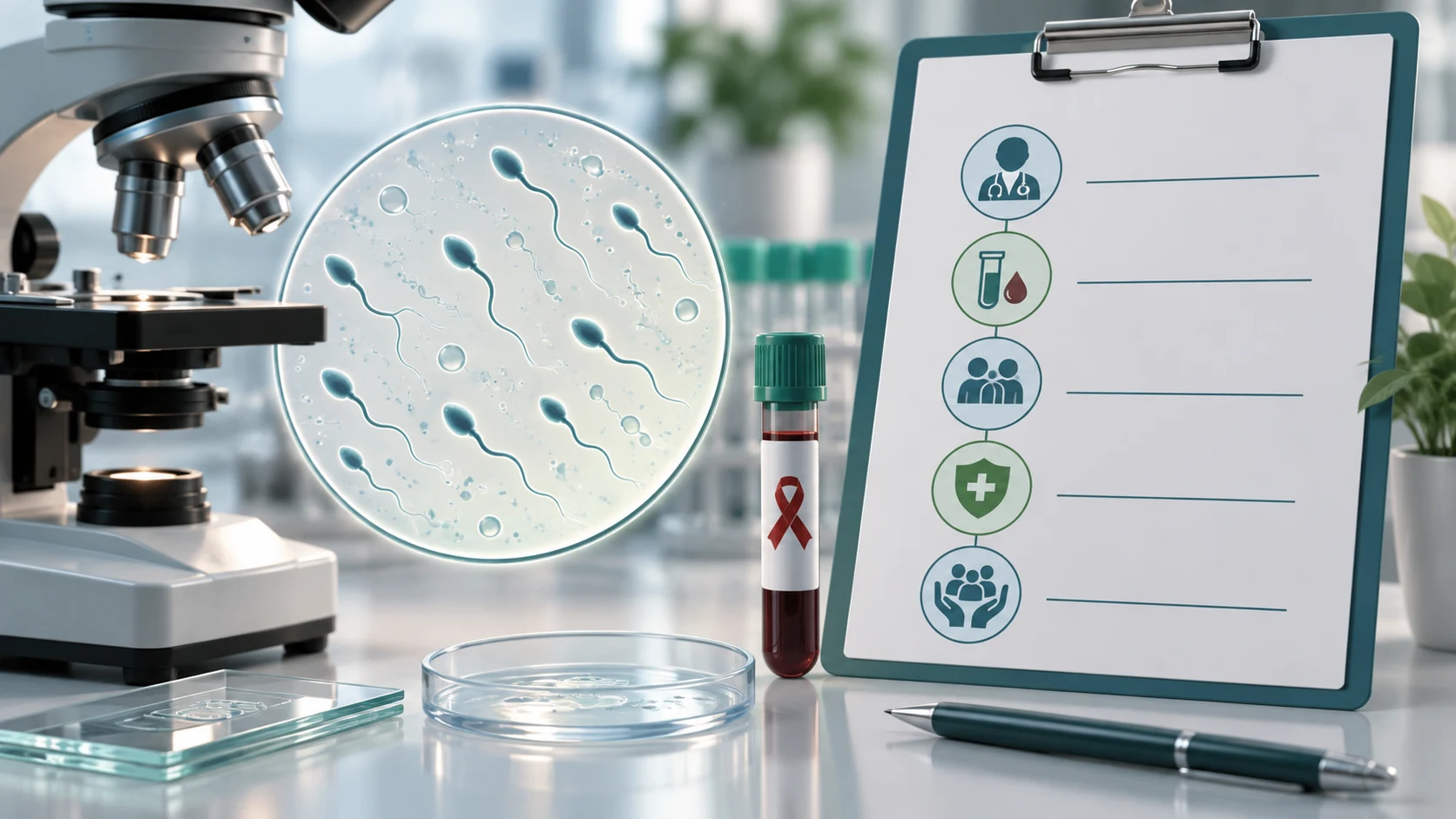
What the New Study Actually Tested
The selected weekly source is a 2026 article in Clinical and Translational Medicine, indexed by Europe PMC under PMID 42723592. The researchers used an HIV-1 transgenic rat model to study mechanisms that may connect chronic HIV-related gene expression with male reproductive dysfunction.
This was not a clinical trial in men. It was a preclinical animal study comparing male HIV-1 transgenic rats with wild-type controls. The paper describes male rats aged 10 to 12 weeks, with 8 to 12 animals per group, and examines testicular structure, sperm count, sperm movement, sperm shape, hormone levels, inflammatory and mitochondrial pathways, CatSper channel expression and transcriptomic patterns.
The reported findings were biologically consistent: reduced testicular weight and volume, lower sperm count, lower testosterone and progesterone, abnormal sperm morphology, reduced motility and downregulation of CatSper1-4 channels in the transgenic animals. CatSper channels matter because they help regulate calcium signaling needed for sperm movement and fertilization.
Why This Is Important, But Not a Personal Diagnosis
Animal models help researchers ask mechanism questions that cannot be answered ethically or cleanly in people first. They can show patterns inside tissue, sperm cells and molecular pathways. They cannot tell an individual man whether he is fertile, whether he can safely conceive, or whether his semen analysis will be normal.
The study also has limits that matter for interpretation. The model reflects chronic HIV-1 gene expression, but it does not fully reproduce every real-world situation: antiretroviral therapy, different viral histories, age, other infections, substance use, medications, diabetes, varicocele, testosterone exposure and relationship context can all change the clinical picture.
That is why the most honest conclusion is practical rather than dramatic. The study supports taking male fertility seriously in HIV care. It does not support fatalism, stigma, or any claim that a man can know his fertility status without clinical testing.
What Men Living With HIV Should Ask
A man living with HIV who wants children someday does not need to wait until a crisis to ask reproductive questions. He can ask his HIV clinician whether his viral load is suppressed, whether his current antiretroviral regimen has any fertility or sexual side-effect considerations, and whether semen analysis or urology referral makes sense for his situation.
NIH clinical guidance recommends expert consultation when conception is desired and one or both partners have HIV, so safer conception can be tailored to the couple's needs. It also notes that care coordination may involve HIV primary care, reproductive endocrinology and infertility, obstetrics and gynecology, case management and peer or social support.
A semen test is a useful data point, not a judgment of masculinity. 정액 분석 및 남성 불임의 기초 explains why concentration, motility and morphology are interpreted together, and why a single mildly abnormal result does not automatically mean in생식 능력.
- Ask whether your HIV is durably suppressed and how often viral load should be checked.
- Ask whether semen analysis is appropriate before trying to conceive.
- Ask whether testosterone, prolactin, thyroid or other hormone testing is clinically indicated.
- Ask which specialist should coordinate 생식 능력 care if pregnancy does not occur.
Viral Suppression Is Central to Safer Planning
Fertility planning with HIV is not only about sperm quality. It is also about HIV transmission prevention, partner safety and shared decision-making. CDC states that HIV treatment reduces viral load, and that a person with an undetectable viral load will not transmit HIV to others through sex.
NIH guidance uses a specific clinical threshold: people with HIV who take antiretroviral therapy as prescribed and maintain viral load below 200 copies per milliliter will not transmit HIV to their sex partners. For partners with different HIV status who want to conceive, guidance also discusses PrEP for the partner without HIV, STI screening, viral-load monitoring and expert consultation.
This is reassuring, but it is still medical. A man should not rely on memory, old lab results or guesswork. If conception is being planned, the care team should confirm current viral suppression, medication adherence, STI status and the partner's prevention preferences.
How Semen Analysis Fits the Picture
CDC describes male infertility evaluation as typically including semen analysis, complete medical history and physical examination. A semen analysis looks at sperm concentration, motility and morphology. In plain language: how many sperm are present, how they move and how they are shaped.
That maps neatly onto the questions raised by the new study, because the rat model showed abnormalities in count, movement and morphology. But a lab model cannot replace the man's own clinical test. Semen results can be affected by fever, timing since last ejaculation, recent illness, medications, heat exposure, smoking, alcohol, anabolic steroids, testosterone use and collection conditions.
If results are abnormal, the next step is usually confirmation and context rather than panic. A clinician may repeat the test, review medications, check hormones, evaluate for varicocele or infection, discuss lifestyle factors, or refer to a reproductive urologist or fertility clinic.
성적 건강 증상 Still Matter
Fertility concerns often overlap with sexual symptoms. Erectile changes, low desire, delayed ejaculation, painful ejaculation, testicular discomfort, pelvic pain or anxiety about transmission can all affect a man's reproductive life. Some are related to HIV care, some to medications, some to cardiovascular or hormone health, and some to stress or relationship context.
For 발기 changes, the 발기부전: 의료 지도 is a safer starting point than assuming one cause. ED can be vascular, hormonal, neurological, medication-related, psychological or mixed, and it can sometimes signal broader cardiometabolic risk.
A useful appointment script is simple: I live with HIV and may want children; I want to know whether my viral load, semen health, hormones or medications need review. Direct language helps the clinician route the issue instead of treating fertility as a private afterthought.
Where 바디워크 Fits and Where It Does Not
Jab Kasai, Thai bodywork and pelvic relaxation work belong in a supportive, non-medical lane. For some medically stable adults, respectful touch may help with body awareness, stress, pelvic guarding or confidence. It should never be presented as HIV treatment, viral-load support, fertility restoration or safer-conception care.
The distinction matters because men living with HIV may already carry stigma. A practitioner should not add shame by implying that sperm quality reflects cleanliness, masculinity or moral worth. The ethical role is consent-based support, careful boundaries and referral when medical questions appear.
Jab Kasai와 출산력: 과학적 주의 makes the same point for traditional 골반 and 고환의 bodywork: cultural context matters, but 생식 능력 claims require clinical evidence.
위험 신호 That Need 의학적 관리
Some situations should bypass wellness interpretation. A man should seek prompt medical care for new testicular swelling, sudden severe testicular pain, a hard testicular lump, blood in semen or urine, fever with pelvic or genital pain, painful urination, genital ulcers, new discharge, severe pelvic pain, inability to urinate or symptoms after a possible HIV exposure.
HIV-specific care also has its own red flags: missed antiretroviral therapy, unknown or rising viral load, possible acute HIV symptoms after exposure, untreated STIs, partner exposure concerns, or plans to conceive without current clinical guidance. These are not problems for massage, supplements or online reassurance.
Mental health belongs in the safety frame too. Fertility fear, shame after diagnosis, sexual avoidance and relationship distress are common enough to deserve support. A clinician, counselor or HIV support service can help turn private worry into a plan.
How to Prepare for a 생식 능력 Conversation
Before an appointment, write down the most recent viral-load result, CD4 count if known, current antiretroviral medicines, missed doses, STI history, fertility goals, previous pregnancies with partners, prior semen analysis, testosterone or hormone treatment, anabolic steroid use, recreational drug use, heat exposure, testicular injury and any sexual symptoms.
If a partner is involved, discuss what each person needs from the visit: transmission prevention, pregnancy timing, donor sperm, assisted reproduction, PrEP, testing, privacy or counseling. NIH guidance recognizes that people with many family structures may seek options to build families, including donor gametes, surrogacy and adoption.
The goal is not to turn every man into a specialist. The goal is to avoid silence. HIV care has changed dramatically, and many men can live long, healthy lives with effective treatment. Fertility planning should be part of that reality when it matters to the person.
This article is educational only. It does not diagnose infertility, HIV status, hormone deficiency or infection; it does not replace antiretroviral therapy, PrEP, semen analysis, fertility care, STI testing or medical advice from HIV, urology or reproductive specialists.
Conclusion
The new HIV fertility study is important because it makes male reproductive health harder to ignore. It points to plausible biological pathways involving testicular structure, hormones, sperm movement, sperm shape, mitochondrial stress, immune signaling and CatSper channels.
For men, the practical lesson is grounded and humane: know your HIV status, stay in care, confirm viral suppression, ask about semen analysis when fertility matters, and involve the right specialists early. JABKASAI can support honest body awareness, but the fertility and HIV decisions belong in clinical care.
Frequently asked questions
Does HIV automatically make a man infertile?
No. The new study was an animal-model study, not a diagnosis for men living with HIV. HIV and possibly antiretroviral drug use can be associated with semen abnormalities, but an individual man's fertility can only be assessed through clinical history, examination and appropriate testing such as semen analysis.
Can a man with HIV have biological children safely?
Many men with HIV can plan parenthood with medical guidance. NIH guidance says expert consultation is recommended when conception is desired and one or both partners have HIV. Viral suppression, STI screening, PrEP discussion and fertility evaluation may all be part of safer planning.
What is the first test to ask about?
If fertility is the question, semen analysis is often central because it assesses sperm concentration, movement and shape. The clinician may also review viral load, medications, sexual symptoms, hormone concerns, testicular history and partner factors before deciding which tests are useful.
Can 잡 카사이 improve sperm quality in men with HIV?
No evidence supports Jab Kasai or massage as a way to improve sperm quality, treat HIV, reduce viral load or prevent transmission. Bodywork can only be considered supportive for medically stable adults, with consent and clear boundaries, and it should never replace HIV or fertility care.
When should a man seek urgent care instead of waiting?
Sudden severe testicular pain, rapid swelling, fever with genital or pelvic pain, a hard lump, blood in urine, inability to urinate, genital ulcers, discharge, possible recent HIV exposure, or concerns about missed HIV medication and rising viral load should be routed to qualified medical care.
관련 JABKASAI 가이드
주제
검토된 소스
- Europe PMC record for PMID 42723592 — Europe PMC
- 고환의 toll with viral intrusion: Molecular insights into the impact of chronic HIV infection on male 생식 능력 — Clinical and Translational Medicine / Wiley
- Reproductive Options When One or Both Partners Have HIV — NIH ClinicalInfo
- About HIV — Centers for Disease Control and Prevention
- In생식 능력: Frequently Asked Questions — Centers for Disease Control and Prevention