Medical schema
How to read this guide safely
This visual map connects Testosterone and the Testicles: Hormone Production Basics to anatomy, symptom triage, professional care and the limits of bodywork claims.
- 01
Observe the pattern
Track side, onset, swelling, lump, heaviness, fever, injury, fertility context and pain severity.
- 02
Check red flags
Sudden severe testicular pain, swelling, nausea, trauma or a new lump is not a massage topic.
- 03
Choose the care path
Urgent care, urology, ultrasound or fertility assessment may be needed depending on the pattern.
- 04
Keep clear boundaries
Sensitive bodywork requires explicit consent, hygiene and a stop rule after medical red flags are excluded.
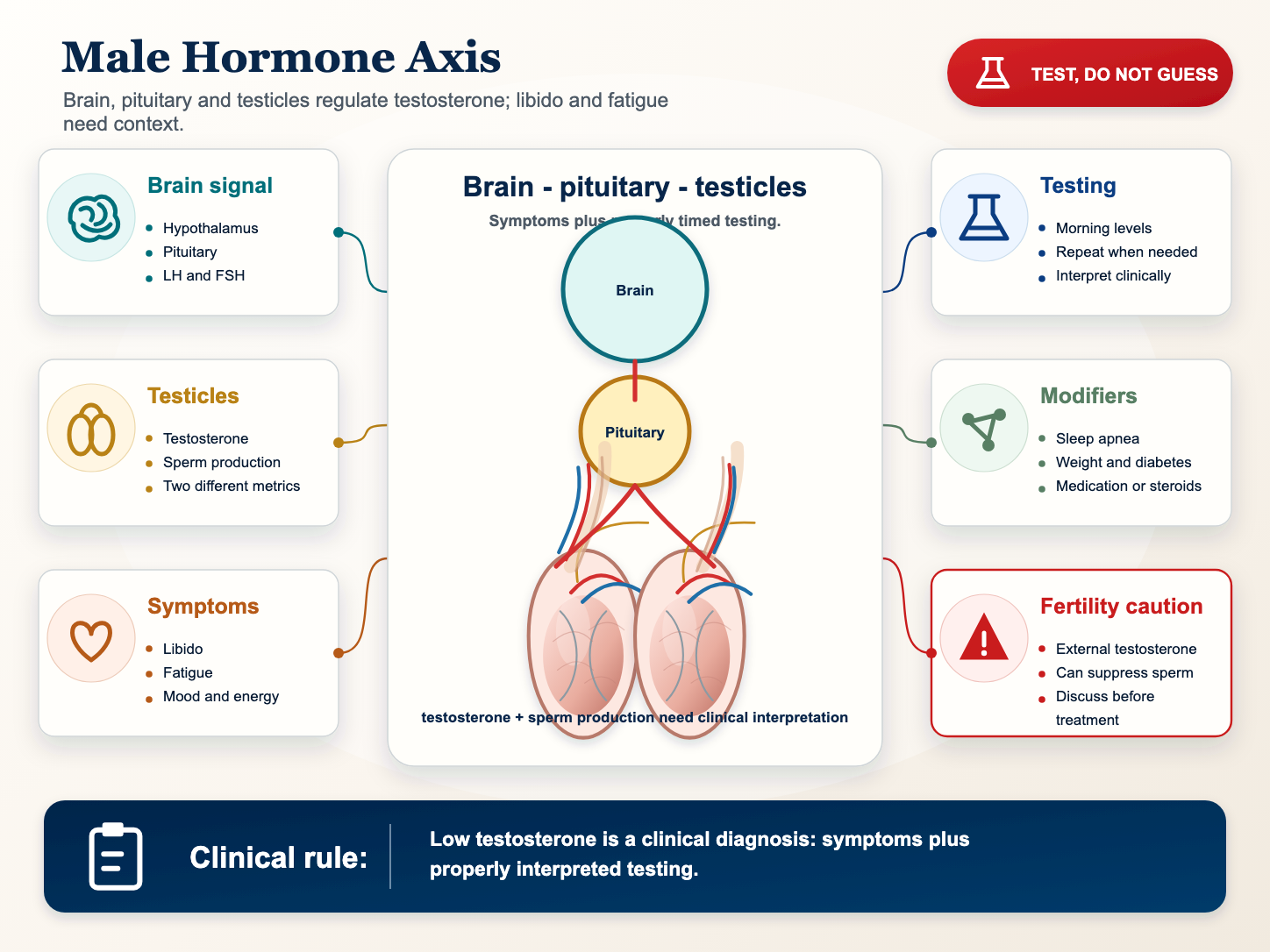
The testicles produce testosterone in response to hormonal signals from the brain, and the pathway can be affected by testicular, pituitary, hypothalamic, medication and general health factors.
This guide is written for adults who want clear testicular health information before interpreting Jab Kasai, testicular massage or any male pelvic bodywork claim. It is educational only. It does not diagnose, treat or replace a doctor, urologist, reproductive specialist, sexual-health clinician or pelvic floor physiotherapist.
Why this subject belongs on the Testicles and Jab Kasai page
The Testicles and Jab Kasai section sits at a delicate intersection: traditional Thai bodywork language, male health anxiety, fertility questions, sexual confidence, pain, and real medical warning signs. A useful subpage must respect that whole intersection. It should give enough context for a reader to ask better questions, while preventing the dangerous idea that sensitive symptoms can be solved by pressure, endurance or vague wellness promises.
The testicles produce testosterone in response to hormonal signals from the brain, and the pathway can be affected by testicular, pituitary, hypothalamic, medication and general health factors. That starting point keeps the subject grounded. The testicles are not abstract symbols of masculinity. They are organs with blood vessels, nerves, reproductive function, hormone function, surrounding ducts and a position inside a scrotal sac designed for temperature regulation. That anatomy is why a cautious tone is not optional.
What is normal, and what is not enough to decide alone
Energy, libido, erections, mood and muscle changes can be influenced by many factors. Symptoms alone do not prove low testosterone.
The most useful habit is to know your own baseline. Baseline means the usual size, shape, position, sensitivity and texture of both sides. It also includes what is normal after exercise, sex, long sitting, cycling, stress, warm weather or a minor bump. Baseline does not mean that every change is harmless. It means that change can be described clearly when speaking to a clinician.
Online reading often creates two bad reactions: panic or dismissal. Panic leads to repeated checking, squeezing and searching. Dismissal leads to ignoring a new lump, swelling, persistent ache or infection sign. A calmer middle path is better: notice the change, record timing and associated symptoms, and choose the right next step. If the change is new, intense, persistent or unclear, the next step is assessment.
Symptoms and patterns to watch
Persistent low libido, fatigue, infertility concerns, reduced morning erections, mood changes, breast tenderness, testicle size change or delayed puberty history deserve a medical conversation.
Timing is one of the most important details. Sudden severe pain is different from a mild ache that appears after long sitting. One-sided swelling is different from general heaviness after heat or exercise. Pain with fever, urinary burning, discharge or blood is different from a short-lived sensitivity after pressure. A testicle that seems higher, rotated, rapidly swollen or very painful should not be watched casually.
Location also matters. A man may say testicle pain when the sensation is actually in the scrotal skin, epididymis, spermatic cord, groin, lower abdomen, perineum, prostate region, pelvic floor or referred from the urinary tract. That does not mean the pain is imaginary. It means the felt location is not always the source. Better description helps professionals sort the possibilities without guessing.
Do not use Jab Kasai, testicular massage, stretching, heat, deep pressure or repeated self-checking to investigate sudden severe pain, swelling, fever, trauma, a new lump, discharge, blood, urinary symptoms or rapidly worsening discomfort. Those patterns need qualified medical assessment.
How clinicians may think about it
Evaluation can involve morning blood tests, repeat testing, medication review, sleep and metabolic assessment, fertility planning and interpretation by a qualified clinician.
Clinical thinking is not simply a list of scary diagnoses. It is a sorting process. The first question is whether the situation could be urgent. The second is whether infection, inflammation, vascular problems, hernia, trauma, a mass, fertility issues, hormone problems or referred pelvic pain should be considered. The third is which tests or referrals are appropriate. That sequence protects the reader from both over-treatment and under-reaction.
Some patterns need emergency care. Some need prompt but non-emergency review. Some can be discussed at a scheduled appointment. Some are mainly education and reassurance after examination. The difference cannot always be known from a website page, which is why the wording here stays conservative. Conservative does not mean fearful; it means matching the response to the risk.
Jab Kasai and bodywork boundaries
No testicular massage or Jab Kasai session can diagnose testosterone deficiency or reliably raise hormone levels. Claims should stay modest.
Traditional language may speak about circulation, vitality, blocked energy, pelvic release or male confidence. Those words can belong to a cultural or wellbeing conversation. They should not be converted into claims that a practitioner can treat torsion, infection, cancer, varicocele, infertility, low testosterone, chronic pelvic pain or erectile dysfunction. The more medical the claim, the higher the evidence standard should be.
A serious practitioner should be able to say what is included, what is excluded, whether touch is external only, how draping works, what hygiene steps are used, what pressure range is acceptable, how the client stops, and which symptoms cancel the session. If those details are not clear, the session is not ready. If symptoms are present, the session may not be appropriate at all.
Questions to ask before interpreting a claim
- Is this claim about cultural tradition, subjective relaxation, body awareness, or a measurable medical outcome?
- If a medical outcome is promised, what evidence supports it and who is qualified to evaluate it?
- Are red flags being screened before touch, or is the practitioner assuming every concern is tension?
- Does the practitioner explain consent, draping, hygiene, pressure and the right to stop without embarrassment?
- Is the client being encouraged to seek medical assessment when pain, swelling, infection signs, fertility concerns or a new lump are present?
What to record before a medical visit
Good notes make sensitive appointments easier. Record when the concern started, whether it was sudden or gradual, whether it is one-sided or both-sided, whether there is swelling or a lump, whether pain changes with standing, sitting, sex, urination, bowel movements, exercise or rest, and whether fever, discharge, blood, nausea, trauma or urinary symptoms are present.
Also record relevant background: recent STI risk, urinary infection, heavy lifting, cycling, groin injury, previous surgery, undescended testicle history, fertility goals, semen analysis results, anabolic steroid use, testosterone treatment, major illness, medication changes and recent bodywork. These details are not there to create shame. They help the clinician choose the right path.
Common misunderstandings
If it does not hurt, it must be harmless. Not always. Some important scrotal findings can be painless. A new lump or swelling should be checked even without pain.
If it hurts, massage will release it. Pain is not proof of blockage. Pain can reflect torsion, infection, trauma, inflammation, referred pelvic pain or other causes that should not be tested through pressure.
If a tradition is old, it is automatically safe. Tradition can be meaningful and still require modern safety screening. A responsible tradition knows when not to proceed.
If a practitioner is confident, the claim is proven. Confidence is not evidence. Fertility, hormones, infection, masses and vascular issues require appropriate clinical standards.
How to use this information
Use this page as a map, not as a diagnosis. If the concern is curiosity about the cultural meaning of Jab Kasai, keep expectations modest and choose a practitioner who is transparent, non-erotic and safety-minded. If the concern is a symptom, use the symptom to choose care first. Bodywork belongs after safety, not before it.
The safest editorial position is simple: testicular health deserves dignity, not sensationalism. Men should be able to discuss lumps, pain, swelling, fertility, hormones and bodywork boundaries without shame. They should also be protected from miracle claims that turn uncertainty into a service package.
For practical use, keep three records separate: what you feel, what you fear and what has actually been checked. What you feel includes pain, pressure, heaviness, swelling or a change in texture. What you fear may include cancer, infertility, sexual decline or embarrassment. What has been checked is the clinical layer: examination, ultrasound, urine test, STI test, semen analysis or blood work when indicated. Keeping those layers separate reduces panic and also prevents false reassurance.
Bottom line
The testicles produce testosterone in response to hormonal signals from the brain, and the pathway can be affected by testicular, pituitary, hypothalamic, medication and general health factors. The practical conclusion is to separate three categories. Culture and tradition can be discussed respectfully. Relaxation and body awareness can be framed as possible wellbeing experiences for appropriate adults. Medical symptoms and measurable outcomes need qualified assessment and evidence.
When those categories stay separate, the reader gains real choice. They can appreciate Thai bodywork language without confusing it with diagnosis. They can choose a practitioner without surrendering boundaries. They can seek medical care without feeling embarrassed. That is the standard this section is built to protect.