Educational content by JabKasai Longevity. Editorial policy
Content updated:
The deepest abdominal techniques in the source work near large blood vessels and the psoas muscle. This is where screening for an aortic aneurysm matters most.
This page summarises how published sources describe a technique, with the anatomy and safety rules a practitioner needs. It does not replace supervised, in-person training, and it is not evidence that the technique treats any condition. In Thailand, Ministry of Public Health officials have said kasai massage is a treatment that belongs in licensed Thai traditional medicine settings, not general massage shops.
The source includes a technique it calls aorta and vena cava release. The abdominal aorta runs down the midline behind the navel. In men over 65, smokers and people with high blood pressure, it can be weakened and widened (an abdominal aortic aneurysm), often without symptoms. Deep pressure over the midline is unsafe in that situation. If you feel a strong, wide or pulsing mass, stop, do not press, and advise a medical check.
The techniques
1. Feeling the abdominal pulse (aorta and vena cava release in the source)
What the source describes.
Sinking slowly towards the midline above the navel until the pulse is felt, then holding with soft contact, described as releasing the main vessels.
Anatomy under the hands.
Abdominal aorta and inferior vena cava, lying on the spine behind the intestines.
Position.
Client on the back, knees supported.
Pressure and pace.
For a practitioner, the useful part is recognising the pulse so that later deep work can avoid it. Contact over the pulse should stay light and short. Never push on the vessel itself.
Do not / stop if.
- a pulse that feels wide, very strong, or spreads sideways under the fingers;
- known aneurysm, recent vascular surgery or uncontrolled blood pressure;
- back or abdominal pain that appears or worsens during the technique.
2. Psoas release
What the source describes.
Slow fingertip pressure into the lower abdomen, to the side of the midline, to reach the psoas muscle, often while the client gently lifts or turns the leg.
Anatomy under the hands.
The psoas runs from the lumbar spine down to the thigh, deep behind the intestines. Nearby: the ureter, the colon, the femoral nerve and, on the inner side, the iliac vessels.
Position.
Client on the back, knee bent on the side being worked.
How it is performed.
- Find the outer edge of the rectus muscle, halfway between the navel and the hip bone.
- Sink in very slowly on the out-breath, angling towards the spine and away from the midline.
- Ask the client to lift the knee slightly; the muscle tightening under the fingers confirms the position.
- Hold with steady, moderate contact for a few breaths, then come out as slowly as you went in.
Pressure and pace.
Slow entry and exit are the main safety rule. If you meet a pulse, move further out to the side.
Do not / stop if.
- a pulse under the fingers;
- pain shooting into the front of the thigh (femoral nerve);
- cramping, nausea, or pain that remains after release;
- recent abdominal surgery, inflammatory bowel disease, or a hernia.
3. Iliac crest massage
What the source describes.
Working along the upper rim of the hip bone, where abdominal and back muscles attach.
Anatomy under the hands.
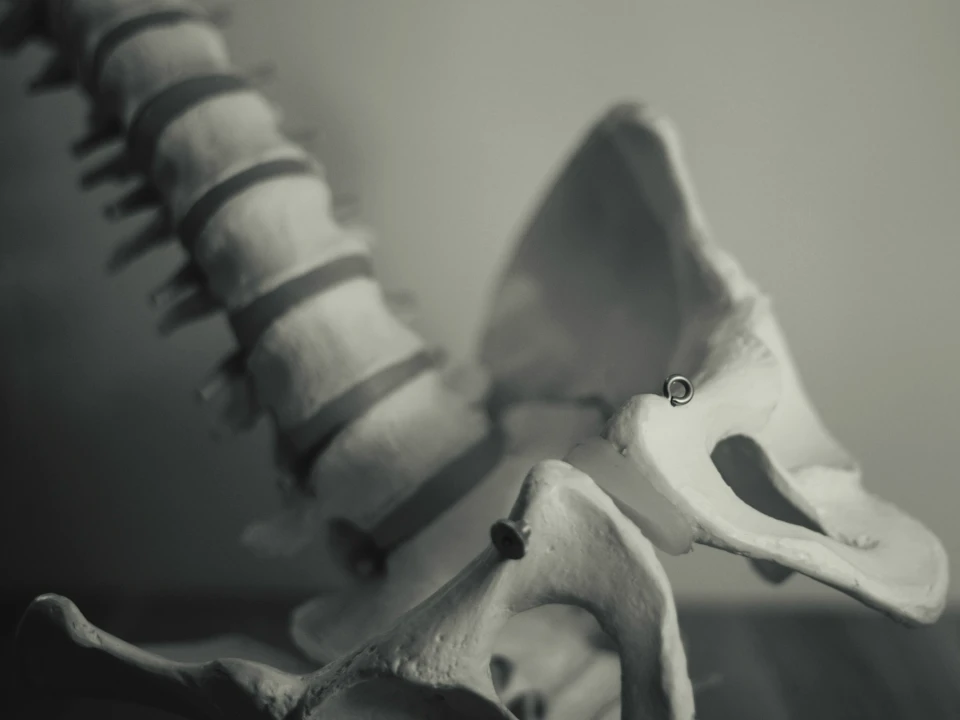
Iliac crest, with the attachments of the oblique abdominal muscles and, at the back, the quadratus lumborum.
Position.
Client on the back, then on the side if needed.
How it is performed.
- Trace the rim of the hip bone with the thumbs from the front point (the anterior superior iliac spine) towards the back.
- Use small circles on tight areas.
Pressure and pace.
Moderate. The bone edge can be tender; stay on muscle rather than grinding on bone.
Do not / stop if.
- sharp pain over the bone;
- numbness or burning on the outer thigh, which can mean an irritated skin nerve near the hip bone.
Smoothing before moving lower
The source ends this stage with long, light strokes over the whole abdomen. It is also the moment to check how the client feels before moving to the groin.